
 Products
 For Distributors
 For Grow Shops
 About Miabis
 Contact
Cleaning cannabis trimming machines is one of the most overlooked factors in post-harvest efficiency, yet it directly impacts performance, downtime, and final product quality.
When growers try to improve trimming operations, they usually focus on speed, capacity, and output. In other words, the main question becomes: how fast can the machine run? This is closely related to the broader decision between manual vs machine trimming, where efficiency, consistency, and labor must be carefully balanced. However, this approach often overlooks a critical constraint.
In reality, many inefficiencies do not come from the machine itself. Instead, they come from how often it needs cleaning, how long that process takes, and how much it disrupts the workflow.
Cleaning, therefore, is not just about hygiene – it is a key driver of operational efficiency.
Why Cleaning Is Not Just Hygiene – It’s Operational Efficiency
In cannabis trimming, residue buildup is unavoidable. Over time, resin and plant material collect on:
- cutting blades
- tumbler surfaces
- airflow systems
- collection areas
This buildup does not just sit there without consequence – it slowly begins to alter how the machine performs. Airflow becomes weaker. At the same time, cutting precision starts to decline, and the movement of material through the system becomes less consistent and more restricted.
At first, these changes are subtle and easy to overlook. However, as residue continues to accumulate, their combined effect becomes more noticeable, eventually reducing overall efficiency and stability in the trimming process.
On the other hand, a clean machine ensures:
- consistent trimming quality
- stable throughput
- predictable, repeatable results
Because of this, cleaning should not be treated as a separate or secondary task, but rather as an integral part of the production process itself.
The Real Cost of Poor Cleaning
Poor cleaning in cannabis trimming machines rarely causes immediate failure. Instead, it creates a chain of small inefficiencies that build over time and gradually reduce overall performance. In fact, these hidden inefficiencies are a common example of where cannabis operations lose money, often without being immediately visible in standard performance metrics.
What makes this especially problematic is that these issues often go unnoticed until they begin to affect output, quality, or workflow stability:
- Downtime Accumulation – Frequent cleaning interruptions break the rhythm of the workflow. Even short stops, when repeated throughout the day, significantly reduce total processing capacity.
- Reduced Trimming Efficiency – As residue builds up, friction increases and cutting performance becomes less effective. This slows down material flow and lowers overall throughput.
- Quality Inconsistency – Dirty components no longer operate under stable conditions, which leads to uneven trimming. As a result, some batches may be over-trimmed while others remain under-processed.
- Material Buildup and Contamination – Residual plant matter can carry over between batches, increasing the risk of contamination and reducing product consistency. In regulated environments, inadequate cleaning can also create compliance risks, especially in facilities operating under GMP or similar quality standards.
- Kief Loss – When surfaces are not properly cleaned, fine particles and resin do not separate and collect efficiently. Instead of being recovered as kief, they remain stuck to machine components or are lost during processing.
Over time, these effects do not remain isolated. They compound and begin to impact the entire trimming operation
Cleaning vs Maintenance: Why Both Matter
Keeping cannabis trimming machines clean is essential, but cleaning alone does not guarantee consistent performance. Without proper maintenance, even a clean machine will gradually lose efficiency, reliability, and precision.
Although closely connected, cleaning and maintenance serve different purposes within the trimming workflow:
- Cleaning is performed regularly and focuses on removing residue while maintaining day-to-day performance.
- Maintenance is carried out to ensure long-term stability and prevent mechanical issues.
In practice,cannabis trimming machine maintenance includes:
- checking blade sharpness
- inspecting moving parts
- ensuring proper airflow
- monitoring wear and tear
When maintenance is neglected, problems rarely appear all at once. Instead, they develop gradually and often go unnoticed until performance is already affected. For example:
- machines may break down unexpectedly
- trimming results become less consistent
- components wear out faster, increasing long-term costs
For this reason, efficient operations do not rely on cleaning alone. They treat maintenance as a structured, ongoing process that supports reliability, extends equipment lifespan, and ensures stable performance over time.
Cleaning Frequency: The Trade-off Between Speed and Stability
Determining how often to clean cannabis trimming machines is not just a routine decision – it is a key factor that directly affects both efficiency and consistency. Cleaning too frequently or not often enough can disrupt the balance between throughput and performance.
On one hand, frequent cleaning interrupts production and reduces overall output. Each stop, even if short, breaks workflow continuity and adds to cumulative downtime.
On the other hand, infrequent cleaning allows residue to build up, which gradually reduces cutting precision, airflow efficiency, and material flow. As a result, machine performance becomes less stable and less predictable over time.
The goal is not simply to clean more or less, but to find the optimal balance between uptime and consistent operation.
This balance depends on several factors:
- whether the material is wet or dry
- resin levels
- machine design
- processing volume
Because of this, professional growers define clear and repeatable cleaning intervals based on their specific workflow conditions. These intervals allow them to maintain both:
- high uptime
- consistent performance
Ultimately, the most efficient operations are not those that clean the most often, but those that clean at the right time – maintaining machine performance without unnecessarily interrupting production.
Labor and Workflow Bottlenecks
Cleaning cannabis trimming machines is often treated as a simple routine task. In practice, however, it plays a much larger role in shaping labor efficiency and overall workflow stability. This challenge is part of a broader shift toward automation in cannabis production, where growers evaluate how labor-intensive processes impact efficiency and scalability.
Unlike automated trimming, cleaning is still largely dependent on manual work. It requires stopping the machine, assigning operators to non-productive tasks, and relying on their experience to perform the process correctly and efficiently.
In many operations:
- cleaning is done manually
- the machine must be stopped
- skilled operators are needed
Because of this, cleaning introduces natural friction into the workflow.
For example:
- operators must pause trimming to perform cleaning
- workflow continuity is disrupted
- labor costs increase as time is spent outside core production
These interruptions may seem minor when viewed individually. However, when repeated throughout a shift or across multiple machines, they begin to compound and create noticeable bottlenecks.
Over time, cleaning becomes more than just a maintenance task – it becomes a limiting factor in how efficiently the entire operation can run. The most effective workflows are therefore not only optimized for trimming speed, but also designed to minimize the labor and disruption associated with cleaning.
Machine Design as a Deciding Factor
The efficiency of cleaning cannabis trimming machines is not determined by process alone – it is heavily influenced by machine design. In other words, how a machine is built directly affects how easy it is to clean, how long it takes, and how often production needs to be interrupted.
Not all trimming machines are designed with cleaning efficiency in mind. As a result, differences in construction can lead to significant variation in cleaning time, labor requirements, and overall workflow efficiency.
Key design factors include:
- how easily components can be accessed
- whether tools are required for disassembly
- how long a full cleaning cycle takes
- whether any parts of the process are automated
These factors may seem secondary at first, but in practice they have a direct impact on performance. Machines that are difficult or time-consuming to clean tend to create more downtime, increase labor demands, and disrupt workflow continuity.
This is why machine selection plays such an important role in operational efficiency.
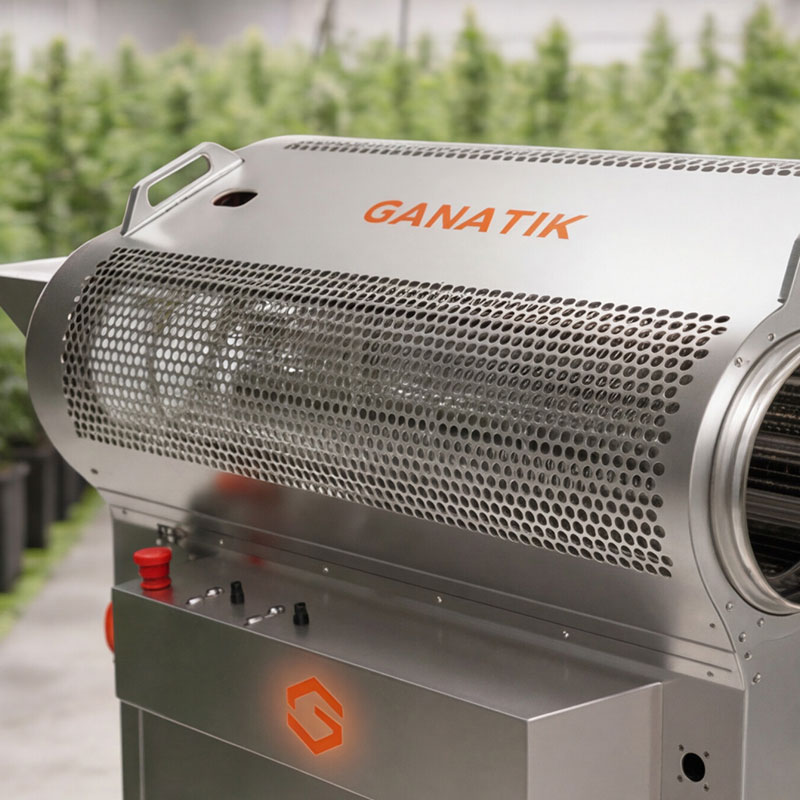
For example, advanced systems like the Ganatik trimmer are designed with cleaning and workflow in mind, not just trimming capacity. Features such as a built-in self-cleaning system reduce the need for manual intervention and shorten cleaning cycles, allowing operators to maintain consistent production with fewer interruptions.
In this context, machine design is not just a technical detail – it becomes a key factor in how efficiently the entire trimming operation can run.
How to Optimize Cleaning Without Losing Throughput
Optimizing how you clean cannabis trimming machines is not about reducing cleaning frequency, but about making the process more efficient and better integrated into the workflow. The goal is to maintain machine performance without creating unnecessary interruptions that reduce overall throughput.
Instead of treating cleaning as a reactive task, efficient operations approach it as a structured part of production.
Here are some key steps:
- Standardize Cleaning Procedures – Define clear and repeatable routines so cleaning is performed consistently, regardless of the operator. This reduces variability, shortens cleaning time, and ensures predictable results.
- Align Cleaning With Workflow Stages – Schedule cleaning during natural pauses in the process, such as batch changes or material transitions, instead of interrupting production at random points.
- Train Operators – Well-trained operators can perform cleaning faster, more effectively, and with fewer errors, which directly reduces downtime and improves workflow continuity.
- Choose Efficient Equipment – Machines designed for easy access, quick disassembly, or automated cleaning significantly reduce the time and labor required, allowing operations to maintain higher throughput with less disruption.
When these elements are combined, cleaning becomes a controlled and optimized process rather than a recurring interruption – supporting both efficiency and consistency across the entire trimming workflow.
The Shift Toward Smarter Trimming Systems
The priorities in cannabis trimming are evolving. While speed and capacity were once the primary benchmarks of performance, they are no longer enough to define an efficient operation.
As workflows become more complex and production scales increase, growers are placing greater emphasis on how smoothly the entire process runs – not just how fast material can be processed.
Today, the focus has expanded to include:
- workflow efficiency
- reduced downtime
- ease of use
This shift reflects a broader understanding of what truly drives performance. It is not just about peak output, but about consistency, stability, and minimizing interruptions throughout the operation.
As a result, modern trimming systems are increasingly designed to reduce operational friction at every stage – including cleaning, maintenance, and handling.
In practical terms, this changes how efficiency is defined:
→ The most effective system is not the one that runs the fastest
→ It is the one that runs consistently, with minimal disruption and maximum uptime
This is where design, usability, and workflow integration become just as important as raw processing speed.
Where Trimming Efficiency Is Really Won or Lost
Cleaning cannabis trimming machines is often underestimated because it does not directly produce output. However, it directly determines how efficiently that output can be achieved.
When cleaning and maintenance are neglected, the consequences are not always immediate, but they are inevitable:
- hidden downtime
- reduced efficiency
- inconsistent trimming quality
- increased labor costs
On the other hand, well-optimized operations approach cleaning as a controlled and integrated part of the workflow. They:
- reduce unnecessary cleaning time
- maintain stable machine performance
- ensure consistent, repeatable results
Ultimately, efficiency in trimming is not defined only by how fast a machine can run, but by how reliably it can keep running.
For this reason, cleaning is not a secondary task or a background process. It is a core operational factor – one that directly defines productivity, consistency, and profitability across the entire trimming operation.
FAQ: Cleaning Cannabis Trimming Machines Efficiently
How often should cannabis trimming machines be cleaned?
Cleaning frequency depends on several factors, including whether the material is wet or dry, resin content, processing volume, and machine design. High-resin material, in particular, causes faster buildup and requires more frequent cleaning to maintain consistent performance. Instead of relying on fixed intervals, professional operations define cleaning schedules based on real workflow conditions to balance uptime and efficiency.
Does poor cleaning affect trimming quality?
Yes, poor cleaning directly affects trimming quality and consistency. Residue buildup reduces cutting precision, disrupts airflow, and changes how material moves through the machine. Over time, this leads to uneven trimming results, including over-trimming or under-trimming, as well as less consistent batch quality.
What is the difference between cleaning and maintenance?
Cleaning focuses on removing resin and plant material to keep the machine operating efficiently on a daily basis. Maintenance, on the other hand, involves inspecting and servicing key components – such as blades, moving parts, and airflow systems – to ensure long-term reliability and prevent mechanical issues. Both are essential for stable performance.
Can cleaning cannabis trimming machines impact profitability?
Yes, cleaning has a direct impact on profitability. Inefficient cleaning increases downtime, raises labor costs, and reduces overall throughput. In addition, poor cleaning can lead to quality inconsistencies and material loss, including kief, which further reduces product value. Optimizing cleaning processes helps maximize both efficiency and output.
Are self-cleaning trimming machines worth it?
For high-throughput operations, self-cleaning trimming machines can significantly improve efficiency. By reducing the need for manual cleaning and shortening downtime, they allow for more continuous production and lower labor requirements. Over time, this leads to more stable workflows and better overall performance.
How can you reduce downtime when cleaning trimming machines?
Downtime can be reduced by standardizing cleaning procedures, training operators, and aligning cleaning with natural workflow breaks such as batch transitions. In addition, choosing trimming machines that are easy to clean or include automated cleaning features can significantly minimize interruptions and improve overall productivity.

 Ganatik
 Re-Plant
 Marketing Support
 Cannabis World
 Terms & Conditions