
 Products
 For Distributors
 For Grow Shops
 About Miabis
 Contact
Manual vs machine trimming cannabis refers to two different approaches to post-harvest processing. Manual trimming offers higher precision and better visual quality, while machine trimming provides speed, consistency and scalability. The best choice depends on the grower’s production size, quality goals and available labor.
Trimming is one of the most critical steps in cannabis post-harvest processing. It directly affects the final appearance, potency perception and overall market value of the flower.
For growers, the question is no longer whether trimming matters – it’s how to do it right. As a result, this leads to one of the most common decisions in post-harvest workflows – manual vs machine trimming cannabis.
Both approaches have clear advantages and trade-offs. However, understanding where each method fits is essential for optimizing quality, efficiency and long-term profitability.
Why Trimming Matters More Than You Think
Trimming is not just about removing excess leaves. In fact, it plays a key role in how the final product is perceived and processed. More specifically, it defines:
- visual appeal (bag appeal)
- trichome preservation
- consistency across batches
- processing speed and labor requirements
For example, poorly trimmed buds can look less attractive and lose part of their market value, even if the genetics and cultivation were excellent. On the other hand, well-trimmed flower creates a clean, premium appearance and improves overall product consistency.
Because of this, trimming should be seen as a value-defining step, not just a finishing task. Trimming is part of a broader post-harvest process, where each step – from drying to handling – directly influences final product quality.
What Is Manual (Hand) Trimming?
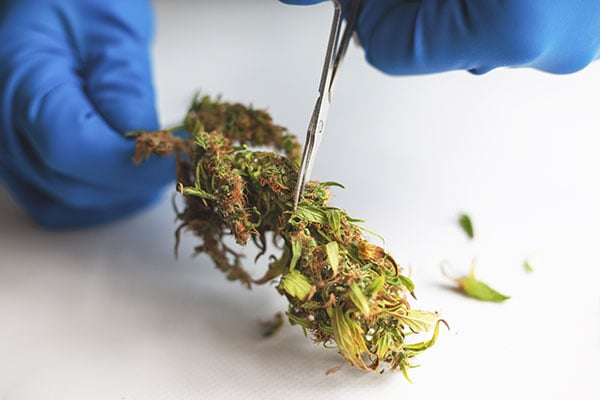
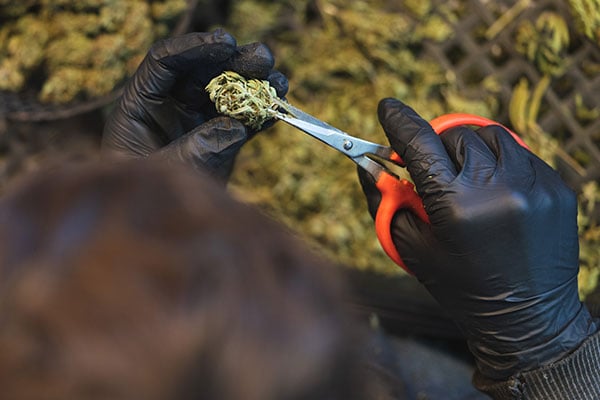
Manual trimming (hand trimming) involves removing excess leaves from cannabis buds using scissors, typically by trained workers. It is the traditional method and still widely used, especially in small-scale or premium production environments where attention to detail is critical.
Advantages of Hand Trimming
Hand trimming gives the grower full control over how each bud is shaped and finished. This results in:
- high precision and control
- better preservation of bud structure
- minimal disturbance of trichomes
- ideal results for premium and craft markets
As a result, hand-trimmed buds often achieve the highest visual quality, which is especially important in top-shelf flower segments.
Limitations of Hand Trimming
However, this level of precision comes at a cost. Manual trimming:
- is extremely labor-intensive
- has slow processing speed
- becomes expensive at scale
- is difficult to standardize across teams
Because of this, as production volume increases, manual trimming quickly becomes a bottleneck in the workflow.
What Is Machine Trimming?
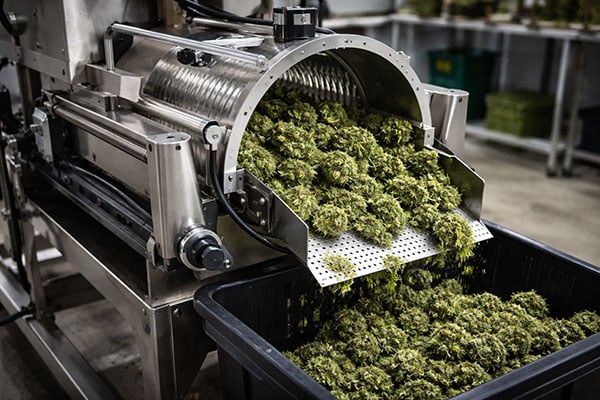
Machine trimming uses mechanical systems to remove excess plant material from cannabis buds. In comparison to manual work, modern machines can process large volumes in a fraction of the time.
Additionally, many machines today support both wet and dry trimming, which allows growers to adapt their workflow depending on drying strategy and operational needs. For dry machine trimming, flower condition, preparation and machine settings play a particularly important role in the final result.
Advantages of Machine Trimming
Machine trimming is primarily designed for efficiency and consistency. Key benefits include:
- significantly faster processing
- consistent and repeatable results
- reduced dependence on labor
- scalability for commercial operations
Because of these advantages, machine trimming enables growers to handle large harvests efficiently, especially when time and labor are limited. At the same time, modern systems can also capture and preserve valuable byproducts such as kief, which would otherwise be lost during processing.
Limitations of Machine Trimming
At the same time, machine trimming has traditionally been associated with certain drawbacks:
- risk of over-trimming if not properly calibrated
- potential damage to delicate buds (especially with lower-quality machines)
- less individual control compared to hand trimming
That said, these limitations increasingly depend on the quality and adjustability of the machine used. Modern systems are designed to minimize these issues.
Manual vs Machine Trimming Cannabis: Direct Comparison
Choosing between manual and machine trimming is not just about preference – it comes down to how each method performs in terms of quality, speed, labor and scalability. Below is a direct comparison based on the most important operational factors.
| Factor | Manual Trimming | Machine Trimming | Notes |
|---|---|---|---|
| Quality | Highest level of precision and visual quality | High consistency, depends on machine settings and design | Modern systems allow more control, reducing the traditional quality gap |
| Efficiency & Speed | Slow, dependent on workforce | Extremely fast, designed for high throughput | For large harvests, machine trimming is often the only viable option |
| Labor Requirements | Requires trained teams | Minimal labor needed for operation | Labor availability and cost are major deciding factors |
| Scalability | Limited scalability | Easily scalable for commercial production | Machine-based workflows support predictable growth |
| Cost Over Time | Ongoing labor costs | Higher upfront investment, lower long-term operational cost | Machine trimming becomes more cost-effective as scale increases |
Overall, modern trimming systems are increasingly reducing the traditional gap between quality and efficiency. Because of that, growers can scale without fully sacrificing product quality. To better understand this relationship, see how trimming speed affects both quality and profitability.
When Does Hand Trimming Make Sense?
Manual trimming is best suited for situations where quality is the top priority and production scale is manageable. In practice, this typically includes:
- producing premium, top-shelf flower
- operating at small scale
- prioritizing visual perfection over speed
- targeting craft or boutique markets
In these environments, each bud is treated as a high-value product. Therefore, the extra time and labor required for hand trimming can be justified by higher selling prices and stronger product differentiation.
When Does Machine Trimming Make Sense?
Machine trimming becomes the better choice when efficiency, speed, and consistency are critical for the operation. This is especially true in situations where growers need to:
- handle large harvest volumes
- work within tight turnaround times
- deal with labor shortages or rising labor costs
- maintain consistent, repeatable results
In these conditions, manual trimming quickly becomes difficult to sustain. As a result, commercial growers often rely on machine trimming as a core part of their post-harvest workflow. Without it, scaling production becomes significantly more difficult.
This decision is also closely tied to the broader question of labor versus automation, where growers must evaluate what truly pays off in the long term.
The Hybrid Approach: Best of Both Worlds
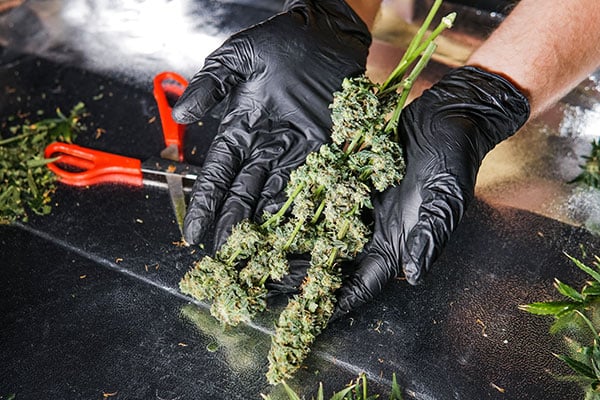
In reality, many growers do not choose one method exclusively. Instead, they combine both approaches to balance quality and efficiency. A common workflow includes:
- Machine trimming for bulk processing
- Hand trimming for final refinement
As a result, this hybrid approach allows growers to process large volumes quickly while still maintaining a high-quality finish where it matters most.
In practice, it is one of the most effective and widely used strategies in modern cannabis production.
The Role of Technology in Modern Trimming Workflows
The traditional perception that machine trimming compromises quality is increasingly outdated. Today, modern trimming systems are designed to give growers control, not just speed. Advanced solutions like Ganatik trimmer represent this shift.
Instead of a one-size-fits-all approach, they allow:
- adjustable processing intensity (speed, airflow, cutting)
- compatibility with both wet and dry trimming
- controlled handling of buds to reduce mechanical stress
- high-capacity workflows with consistent output
Because of this level of control, growers can bridge the gap between manual precision and machine efficiency. In turn, they can fine-tune their process based on strain, moisture level and desired finish.
In other words, machine trimming is no longer just about speed – it’s about workflow optimization.
Efficiency Starts Before Trimming
It’s important to understand that trimming efficiency is influenced by earlier stages of cultivation. More specifically, factors like plant uniformity, root health and growth stability directly impact how easy the trimming process will be later.
Uniform plants are easier to process, more predictable and better suited for machine workflows. On the other hand, inconsistent growth creates more work, slows down processing and reduces overall efficiency.
Solutions like Re-Plant pot help create more uniform plants by eliminating transplant stress and supporting stable root development throughout the growth cycle.
As a result, better inputs lead to better processing outcomes.
Conclusion: It’s Not About Choosing Sides
The debate around manual vs machine trimming cannabis is not about which method is universally better. Instead, it depends on:
- scale of production
- product positioning
- available labor
- workflow efficiency
For some growers, manual trimming remains the gold standard. Meanwhile, for others, machine trimming is the only sustainable option. In many cases, the optimal solution lies somewhere in between.
Ultimately, what matters most is designing a system that delivers consistent quality at the right level of efficiency.
FAQ: Manual vs Machine Trimming Cannabis
Does machine trimming reduce cannabis quality?
Not necessarily. Lower-end machines can damage buds, but modern adjustable systems allow growers to control trimming intensity and preserve quality.
Is hand trimming worth the cost?
It can be, especially for premium flower targeting high-end markets where visual quality justifies the additional labor.
Can you combine machine and hand trimming?
Yes. Many growers use machine trimming for bulk processing and hand trimming for final refinement to balance speed and quality.
Is machine trimming worth it for small growers?
It depends on the scale and goals. For very small grows, manual trimming may still be more practical. However, even smaller operations can benefit from machine trimming when harvest volumes increase or labor becomes a constraint.
How much faster is machine trimming compared to hand trimming?
Machine trimming can process significantly more material in less time. While exact speed depends on the machine and settings, the difference becomes especially noticeable during large harvests where manual trimming would take days or even weeks.
Is wet or dry trimming better for machines?
Both methods can work. Wet trimming is faster and easier to process, while dry trimming can better preserve terpenes. The best choice depends on your workflow and equipment capabilities.
Can machine trimming be adjusted for different strains?
Yes. Modern trimming machines allow adjustments in speed, airflow and cutting intensity. This makes it possible to adapt the process to different strains, bud densities and moisture levels.

 Ganatik
 Re-Plant
 Marketing Support
 Cannabis World
 Terms & Conditions