
 Products
 For Distributors
 For Grow Shops
 About Miabis
 Contact
The hidden costs of inefficiency in cannabis production rarely appear in financial reports, yet they have a direct impact on overall profitability.
Cannabis production costs are usually tracked through visible metrics – labor hours, input costs, energy consumption, and equipment investment. However, these numbers rarely tell the full story. In reality, the most significant financial losses in cannabis operations often come from inefficiencies that are not directly measured.
These hidden costs do not appear as a single expense line. Instead, they accumulate across the production system – through time loss, material waste, underutilized capacity, and repeated manual work. Over time, they quietly reduce margins, limit scalability, and increase cost per gram.
In many cases, inefficiency can reduce overall profitability by 20-30%, even when the operation appears stable on the surface.
Why Inefficiency Has a Direct Financial Impact
Every cannabis operation ultimately runs on one key metric:
→ cost per gram
Cost per gram represents the total cost of production divided by the total output, making it one of the most important indicators of operational efficiency and profitability. Even small inefficiencies affect this number.
Inefficiency increases cost per gram by reducing output while fixed costs remain the same. When production slows down or yield drops, the total cost is distributed across fewer grams, making each gram more expensive to produce.
For example:
- A 10% increase in labor time directly raises production cost
- A 5% loss in yield or recoverable material reduces revenue
- A delay in processing cycles lowers annual output capacity
These effects compound.
A facility that produces 1,000 kg annually does not need a major failure to lose profitability. A combination of slightly higher labor costs, small yield losses, and minor downtime can reduce effective output and increase cost per gram enough to significantly impact margins.
Labor Inefficiency: The Largest Hidden Cost Driver
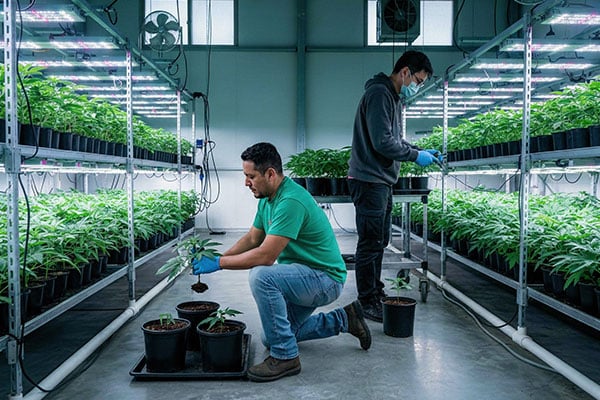
Labor typically accounts for 30-50% of total cannabis production costs, especially in cultivation and post-harvest processing. However, inefficiency is not just about how much labor costs, it is about how effectively it is used.
Hidden labor costs often come from:
- waiting between process stages (e.g. harvest teams waiting for trimming capacity, or harvested material sitting unprocessed while trimming or drying is not ready)
- unnecessary manual handling and repeated tasks (moving plants between stages, transplanting, re-organizing batches)
- inefficient workflow coordination (workers stopping due to cleaning downtime, equipment adjustments, or unsynchronized schedules between teams)
For instance, if workers spend even 30-60 minutes per shift waiting or repositioning materials, the annual cost impact can be substantial.
In a mid-sized facility with 10 employees and average labor cost of €15/hour, just 30 minutes of daily inefficiency results in: €75/day → approx. €18,000 per year in lost productivity.
Instead of contributing to output, this time is spent compensating for inefficiencies elsewhere in the system, directly increasing cost per gram without improving yield, quality, or throughput.
This raises an important operational question: at what point does it make sense to reduce manual labor through better systems or automation? In many cases, the decision is not about replacing labor, but about eliminating inefficiencies that make labor unnecessarily expensive and difficult to scale.
Material Loss: Revenue That Never Gets Counted
Material loss is one of the least visible but most direct financial inefficiencies.
During processing, small amounts of valuable material are often lost:
- kief not collected during trimming
- over-trimming reducing saleable flower weight
- inconsistent handling lowering product grade
Even a 2-5% loss in final product weight or recoverable compounds can significantly impact revenue.
For example, a company with an annual production of 1,000 kg, with an average wholesale price €1.5-€2.5 per gram (depending on market conditions and product quality), a 3% loss results in 30 kg of lost output – equivalent to €45,000-€75,000 in unrealized revenue.
The difference between capturing and losing valuable compounds can affect the performance of an entire batch. Because this loss is rarely tracked precisely, it often goes unnoticed.
Underutilized Space: Hidden Cost per Square Meter
In indoor cannabis production, space is one of the most expensive resources. Costs such as rent or facility investment, lighting, HVAC, and infrastructure are largely fixed – meaning they remain the same regardless of how much you produce. Because of this, efficiency is not only measured in yield per plant, but in yield per square meter (grams/m²).
→ Cost per square meter refers to the total cost of operating a given cultivation area. Since these costs are fixed, the only way to improve profitability is to maximize how much output that space generates.
When space is not used efficiently, the cost per gram increases.
Common issues include:
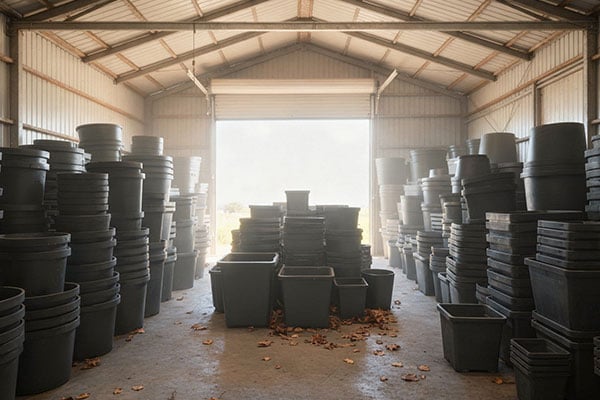
- containers that roots do not fully utilize
- restricted root development limiting plant growth
- inconsistent canopy development
- gaps in plant density or uneven spacing
- storing and managing multiple container sizes
These issues reduce how effectively the available space is used. Even if plants appear healthy, the total output per square meter may be lower than it could be.
If yield per square meter drops by even 10-15%, production costs do not decrease, but output does. This directly increases cost per gram, without any obvious failure in the system.
In other words, two facilities with similar setups can have very different profitability, simply based on how efficiently they use their space.
Efficiency, therefore, is not just about growing plants. It is about maximizing output from every square meter of your facility.
Repetitive Operations: Compounding Labor and Time Costs
Some inefficiencies in cannabis production come from processes that repeat across every cycle.
Typical examples include:
- transplanting plants multiple times
- moving plants between stages or rooms
- cleaning equipment manually between batches
Individually, each of these actions may take only a few minutes per plant or per batch. However, when repeated across hundreds or thousands of plants, the total time and cost quickly become significant.
Take transplanting costs as an example.
In a facility growing 1,000 plants, with 2 transplant stages and an average of 3 minutes per transplant, this results in approximately 100 working hours per cycle. At €15 per hour, this equals €1,500 per cycle. Across multiple harvests, this can exceed €6,000-€9,000 annually in labor costs alone.
And this calculation only includes time. It does not account for plant stress and slowed development, variability between plants, workflow interruptions, and rescheduling. In other words, the real cost is even higher.
This highlights a key principle in cannabis production – if a process repeats, its cost multiplies. Because of this, improving efficiency is not just about making individual steps faster. In many cases, the biggest gains come from removing unnecessary steps entirely.
For example, systems that eliminate transplanting allow the plant to develop continuously in a single container, reducing manual labor, minimizing handling, and stabilizing growth conditions. By removing the need for repeated intervention, growers can significantly reduce both labor costs and operational complexity.
Downtime and Delays: Reduced Output and Lost Capacity
Efficiency is not only about cost, it is also about output capacity. Even when costs remain stable, slower processes directly reduce how much product an operation can produce over time.
In cannabis production, throughput is one of the key performance factors. The faster and more consistently material moves through each stage, the higher the total annual output. When processes slow down, production capacity drops, even if everything else remains unchanged.
Common causes of downtime and reduced throughput include:
- slow trimming speed that cannot keep up with harvest volume
- frequent machine cleaning that interrupts workflow
- workflow interruptions between teams or process stages
If post-harvest processing delays each batch by even 1–2 days, the number of annual production cycles decreases. For example, in a facility running 6 harvest cycles per year, a 2-day delay per cycle results in 12 lost production days annually. This directly reduces total production capacity and revenue potential, without any visible failure in cultivation or product quality.
In other words, the operation produces less simply because the system cannot move fast enough.
Processing systems that increase speed, reduce downtime, and simplify maintenance play a critical role here. For example, faster trimming with consistent performance, combined with self-cleaning functionality, reduces interruptions and keeps workflows running without constant manual intervention. This not only increases throughput, but also reduces operator workload, allowing teams to focus on higher-value tasks instead of stopping production for cleaning and adjustments.
The Compounding Effect: Small Losses, Large Impact
The accumulation of inefficiencies is where the real cost comes from. Even small delays create bottlenecks later, minor material losses reduce total yield, and small labor issues increase total costs.
Consider a typical scenario:
- 10% labor inefficiency
- 3% material loss
- 10% space underutilization
- 2-day downtime per batch
Individually, these may seem manageable. Combined, however, they can:
- increase cost per gram by 20-30%
- reduce total output
- lower overall profitability
This is why many operations feel “busy” and “functional” but still struggle with margins.
How to Reduce Hidden Costs in Cannabis Production
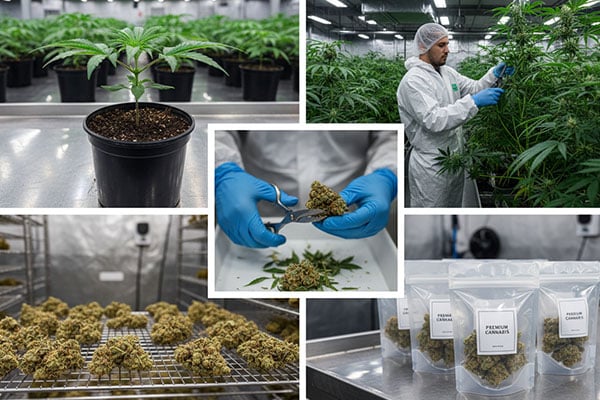
Most cannabis operations try to reduce costs by optimizing individual tasks – improving labor efficiency, adjusting workflows, upgrading equipment, or enhancing plant performance through better genetics, nutrients, and environmental control.
While these improvements matter, they often deliver incremental gains.
The biggest cost reductions come from a different approach: redesigning the system itself. Instead of asking: “How do we make this step faster?”, leading operators ask: “Why does this step exist at all?”. This shift changes how inefficiencies are addressed.
Eliminating unnecessary processes – rather than optimizing them – often delivers significantly greater financial impact. This applies directly to:
- transplanting cycles
- repeated plant handling
- inefficient or interrupted processing workflows
Systems designed to reduce manual intervention, minimize waste, and increase consistency do more than improve efficiency, they fundamentally lower cost per gram.
In other words, the goal is not to improve individual tasks. It is to design a system where those tasks are no longer required or no longer a bottleneck.
Efficiency Defines Profitability
In today’s cannabis market, profitability is not determined only by yield or quality, it is determined by how efficiently that yield is produced.
As the market grows, competition increases and margins shrink. Because of this, efficiency becomes more important than ever.
The hidden costs of cannabis production inefficiency may not always be obvious, but they are always present. They increase cost per gram, reduce output, and limit scalability – and most importantly, they compound over time.
Operations that identify and eliminate these inefficiencies gain a clear and measurable advantage:
- lower production costs
- higher margins
- greater consistency
- more predictable performance
- better scalability
In this environment, efficiency is no longer just an operational improvement. It is a core business strategy and a competitive advantage.
FAQ: Cannabis Production Inefficiency Costs
What are the hidden costs in cannabis production?
Hidden costs in cannabis production include labor inefficiencies, material losses (such as kief loss), underutilized space, repetitive operations like transplanting, and workflow bottlenecks that reduce overall productivity. These costs are often not directly tracked but accumulate across the production system and significantly impact profitability.
How do inefficiencies affect cannabis profitability?
Inefficiencies increase cost per gram, reduce total output, and limit scalability. Even small inefficiencies, such as delays, material loss, or inefficient labor use, compound over time and can significantly reduce overall profit margins.
What is the biggest cost driver in cannabis production?
Labor is typically the largest cost driver in cannabis production, often accounting for 30–50% of total costs. As a result, inefficiencies in labor, such as waiting time, repeated manual handling, and poor workflow coordination, have a major impact on overall profitability.
How does inefficiency increase cost per gram?
Inefficiency increases cost per gram by reducing output while fixed costs remain the same. When production slows down or yield drops, the total cost is distributed across fewer grams, making each unit more expensive to produce.
Can small inefficiencies really impact cannabis operations?
Yes, even small inefficiencies, such as 3-5% losses in time, yield, or material, can have a significant impact when repeated across the entire production cycle. Over time, these small losses compound and lead to substantial reductions in efficiency and profit.
How can cannabis operations reduce hidden costs?
Cannabis operations can reduce hidden costs by redesigning workflows, eliminating repetitive processes, improving space utilization, and implementing systems that reduce manual work and increase consistency. The goal is to remove inefficiencies, not just optimize them.

 Ganatik
 Re-Plant
 Marketing Support
 Cannabis World
 Terms & Conditions