
 Products
 For Distributors
 For Grow Shops
 About Miabis
 Contact
Autoflower cannabis plant growers have struggled with the same problem for years: transplanting autoflowers can stunt growth, but starting directly in a final pot creates root-zone issues of its own. Here’s why both traditional approaches have drawbacks – and how a different growing system changes the game.
Autoflower cannabis plants have changed the way many growers approach cultivation. Faster harvest cycles, simpler light schedules and compact growth patterns have made autoflowers one of the most popular choices for both indoor and outdoor growing.
But despite their popularity, one cultivation question continues to divide growers: Should autoflowers be transplanted or planted directly into their final container from the start?
Some growers avoid transplanting completely, believing even small root disturbances can slow growth and reduce yields. Others argue that starting in oversized final pots creates watering problems, weaker root development and slower early growth.
The truth is that both approaches can create stress inside the root zone – one of the most important parts of the entire plant – forcing growers to choose between two imperfect root-zone environments.
Understanding how autoflower roots develop at different growth stages helps explain why this debate exists in the first place – and why modern growers are beginning to move toward completely different cultivation systems.
Why Transplanting Is Risky for Autoflowers
Autoflower cannabis plants behave differently from photoperiod strains because their lifecycle is genetically timed. Unlike photoperiod plants, they do not wait for light schedule changes before entering flowering. That means autoflowers have a very limited vegetative growth window, where every day of healthy growth matters.
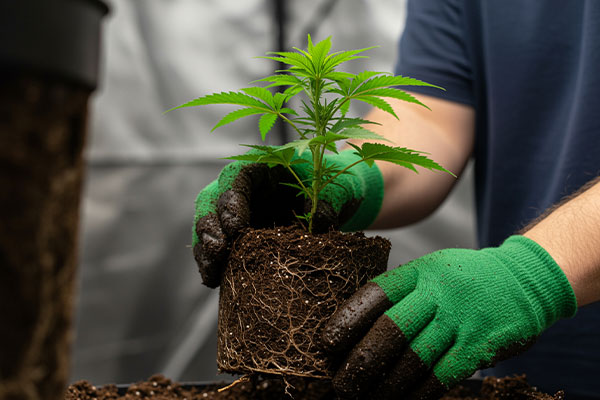
When transplanting – especially when done poorly – the plant experiences transplant shock. This can happen when:
- roots are disturbed,
- the rootball breaks apart,
- roots become compressed or tangled,
- watering conditions suddenly change,
- or environmental stress occurs after repotting.
For photoperiod plants, a few days of slowed growth is usually manageable. The grower can simply extend the vegetative stage and allow the plant to recover. Autoflowers do not have that luxury.
Unlike photoperiod cannabis plants, autoflowers continue progressing toward flowering regardless of stress or recovery time. This means even short interruptions after transplanting can result in:
- smaller plants,
- reduced branching,
- shorter internodal spacing,
- weaker root systems,
- and ultimately lower yields.
This is why autoflower transplant shock has become such a major concern among growers. Even relatively small interruptions during early growth can permanently affect the plant’s final size and productivity.
Why Growing Directly in the Final Pot Also Causes Issues
Because of transplant shock, many growers choose the opposite approach and plant autoflowers directly into their final container from day one.
At first glance, this seems like the perfect solution, since no transplanting means no root disturbance, no recovery period, and no transplant stress. However, oversized final pots create a completely different cultivation problem.
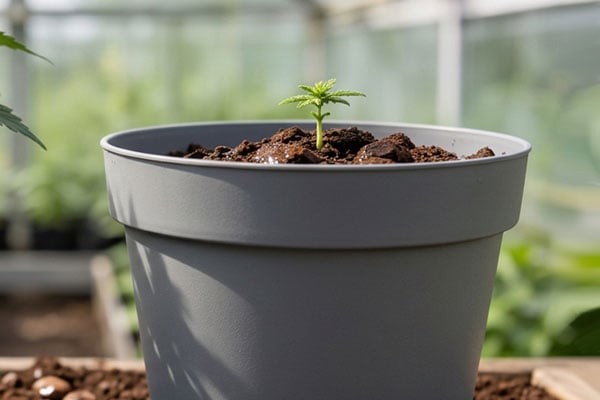
Young seedlings have tiny root systems that cannot efficiently use the entire substrate volume around them. When a small plant sits inside a very large container, excess substrate often remains wet for too long. This leads to several common issues:
- overwatering,
- slow dryback cycles,
- low oxygen levels around roots,
- reduced root expansion,
- and slower early growth.
When large amounts of substrate remain constantly wet, young roots receive less oxygen and have less incentive to aggressively expand through the container. Instead of rapidly building a strong root system, development often slows during one of the plant’s most important growth stages.
Ironically, growers may avoid transplant shock and still experience autoflower stunted growth because the ideal root environment for a seedling is very different from the ideal root environment for a mature flowering plant.
The Real Problem: Autoflowers Need Different Root Conditions at Different Growth Stages
Healthy cannabis cultivation is fundamentally about root management. Strong root development directly influences water uptake, nutrient absorption, oxygen exchange, plant stability and overall growth potential throughout the entire cultivation cycle.
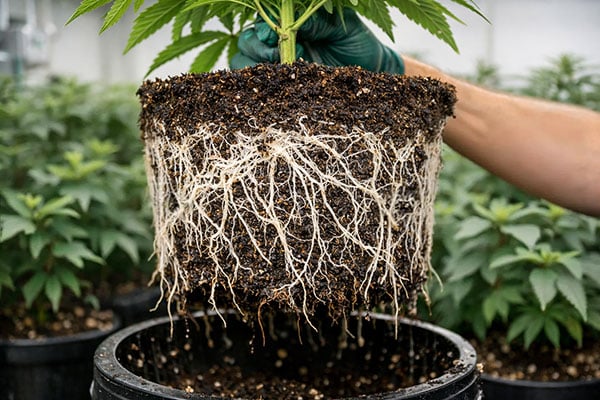
During the seedling stage, plants benefit from:
- smaller root zones,
- faster wet-to-dry cycles,
- precise moisture control,
- and highly oxygenated substrate conditions.
As the plant enters vegetative growth, the root system rapidly expands and requires:
- more substrate volume,
- increased oxygen exchange,
- larger moisture reserves,
- and stronger nutrient uptake.
During flowering, root demand becomes even greater.
Traditional cultivation containers force growers into a compromise. Either start small and transplant later, or start large and sacrifice ideal early-stage root conditions.
This is exactly why transplanting became standard practice in cannabis cultivation in the first place. Growers needed a way to gradually increase root volume as the plant developed.
The problem is that autoflowers are uniquely vulnerable to the stress this process can create.
A Better Way to Grow Autoflowers: The RE-PLANT Approach
For years, autoflower growers have been forced to choose between two imperfect cultivation methods:
- transplanting and risking root stress,
- or starting directly in oversized final pots and sacrificing ideal early root conditions.
The Re-Plant cultivation container was designed to solve this problem differently.
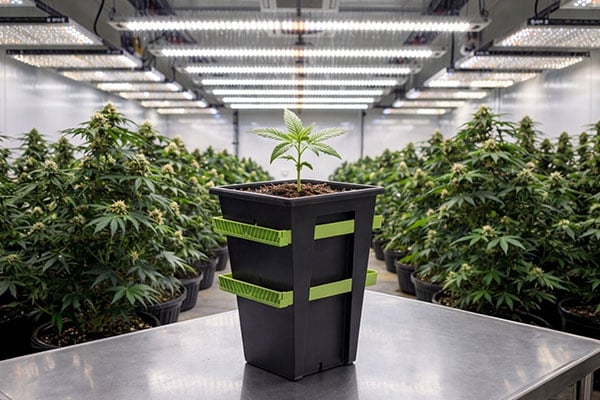
Instead of physically moving the plant between containers, Re-Plant allows growers to progressively expand the root zone inside the same cultivation container. The root environment grows together with the plant, while the root system itself remains practically undisturbed throughout the entire cycle. This creates one of the biggest advantages possible for autoflower cultivation: continuous, uninterrupted growth.
By minimizing root disturbance while still allowing progressive root expansion, Re-Plant combines the main advantages of both traditional methods, without many of their biggest drawbacks.
The patented system uses removable trays that divide the container into three growth levels. As the root system develops, growers simply remove the next tray and instantly expand the available root zone without moving the plant or disturbing the roots.
For autoflower growers specifically, this changes several important aspects of root development and plant performance.
No Growth Interruptions During the Most Sensitive Stage
Because autoflowers operate on a limited vegetative timeline, even short periods of root stress can affect final plant size and overall yield potential.
Traditional transplanting creates temporary growth interruptions while the plant recovers from root disturbance and adapts to a new container environment. With the Re-Plant Container, the plant remains inside the same container throughout the entire grow cycle, allowing the root system to stay practically undisturbed.
There is:
- no rootball handling,
- no tearing of feeder roots,
- no transplant recovery phase,
- and no interruption to growth momentum.
For autoflower growers, maintaining uninterrupted growth during the vegetative phase can make a major difference in final plant performance.
Better Root Development During Early Growth
Young autoflower seedlings perform best in smaller, controlled root zones where moisture levels, oxygen availability and dryback cycles remain easier to manage.
One of the biggest challenges with oversized final pots is that excess substrate often stays wet for too long during early growth. This can slow root expansion and increase the risk of overwatering-related stress.
The Re-Plant container approaches this differently by allowing growers to begin with a smaller active root volume and gradually expand it as the plant develops.
This helps create:
- more balanced moisture conditions,
- improved oxygen availability,
- stronger root establishment,
- and more efficient early vegetative growth.
Instead of overwhelming young roots with excessive unused substrate, the root zone evolves progressively together with the plant itself.
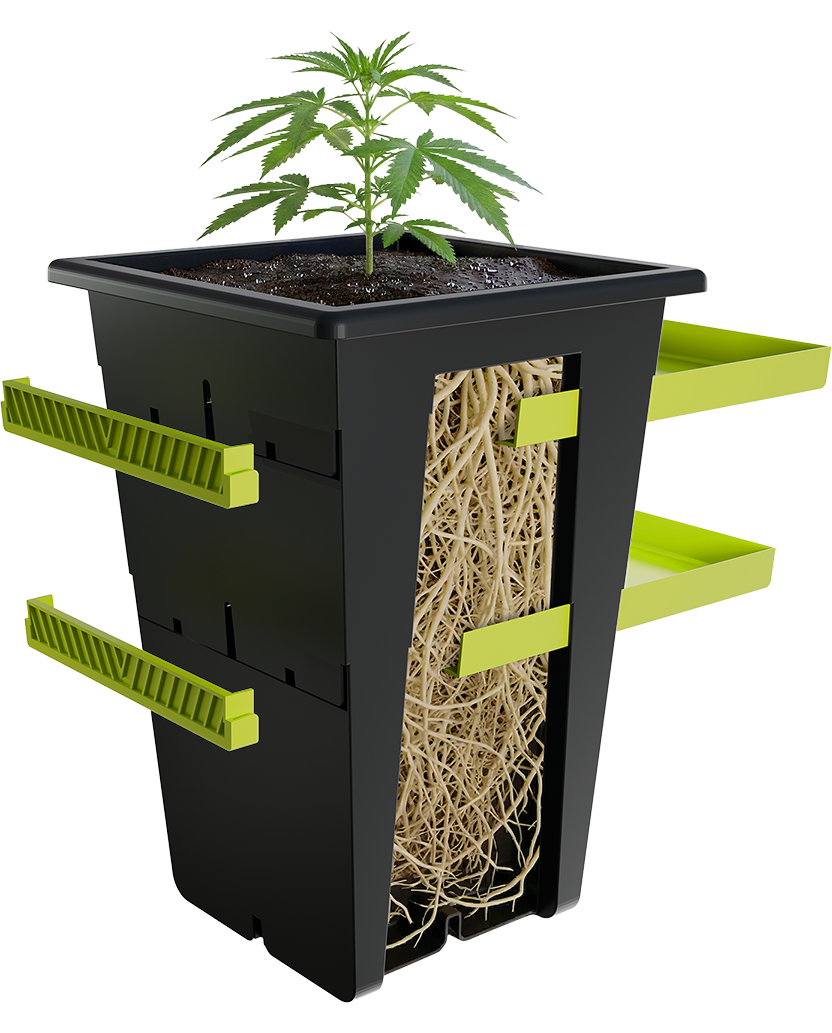
A Root Zone Designed to Grow With the Plant
Traditional cannabis containers force growers into a fixed root-zone environment from seedling to harvest, even though the plant’s requirements change dramatically throughout the grow cycle.
The Re-Plant container solves this by using a patented removable tray system that divides the container into three growth levels. As the autoflower develops, growers simply remove the next tray to instantly unlock additional root volume, without moving the plant itself.
This creates a staged root-development process where the available substrate volume expands together with the plant’s actual growth demands.
For autoflowers specifically, this allows growers to combine:
- the controlled conditions of smaller early-stage containers,
- the larger root volume needed later during flowering,
- and the ability to avoid traditional transplant stress entirely.
Continuous Oxygen Supply
Healthy cannabis roots require continuous oxygen exchange to support vigorous growth and efficient nutrient uptake.
The Re-Plant Container includes side airflow openings designed to improve root-zone aeration throughout the cultivation cycle.
For autoflower growers, maintaining a highly oxygenated root environment becomes especially important during early development, when root expansion directly influences future plant growth.
Improved airflow around the root zone can help support:
- stronger root branching,
- reduced root spiraling,
- healthier nutrient uptake,
- better moisture balance,
- and more vigorous overall development.
Combined with progressive root-zone expansion, this creates a more stable and optimized environment for autoflower cultivation from seedling through harvest.
In practical terms, Re-Plant combines:
- the advantages of starting small,
- the benefits of finishing large,
- and the safety of avoiding transplant shock entirely.
RE-PLANT: One Pot. Three Levels. Zero Transplanting.
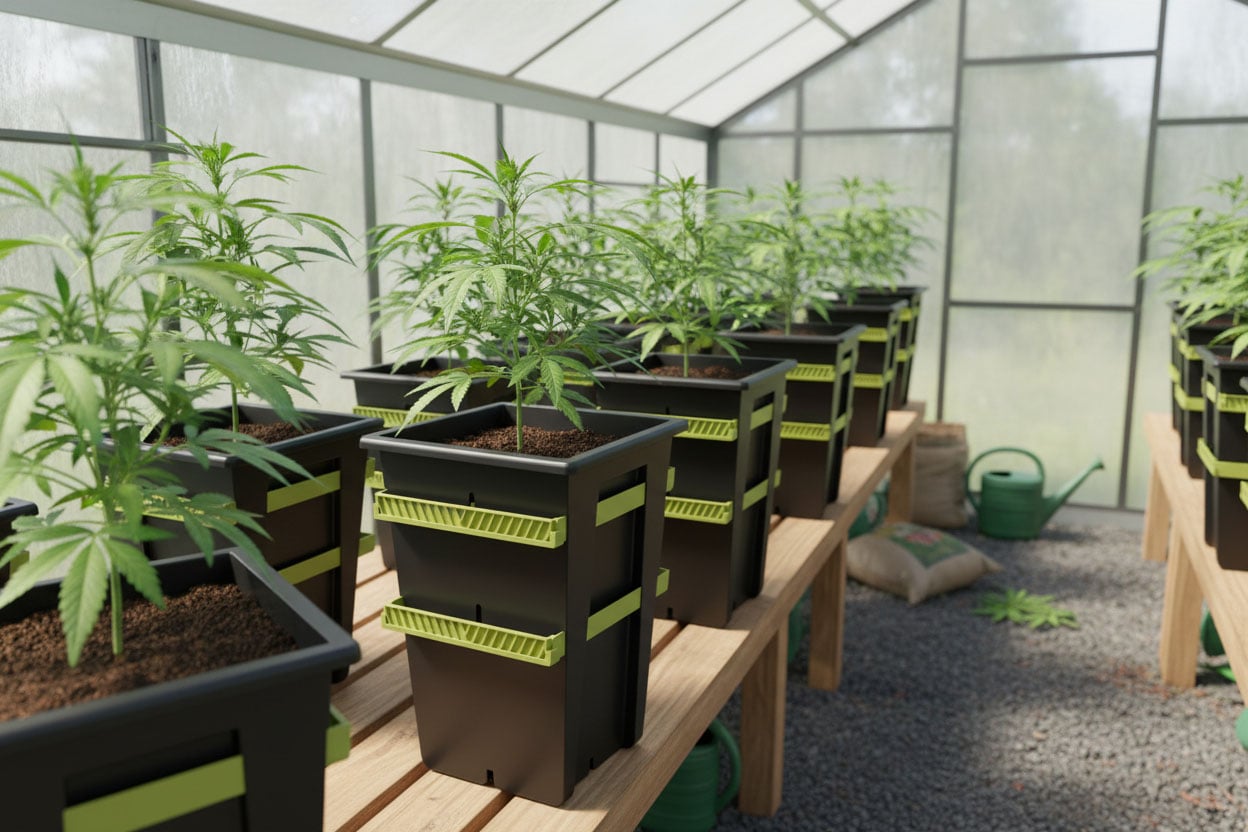
Is Transplanting Autoflowers Always Bad?
Transplanting always creates some level of stress for the plant, even when done correctly. Experienced growers can reduce transplant shock by:
- transplanting very early,
- keeping the rootball intact,
- maintaining stable moisture levels,
- and minimizing root disturbance as much as possible.
The challenge with autoflowers is that they simply have less time to recover from interruptions in growth than photoperiod plants. Even when transplant stress is minimized, the plant still needs to redirect energy toward root recovery and environmental adaptation.
Because of this, reducing root stress wherever possible becomes one of the most important factors in successful autoflower cultivation.
Root-zone management directly influences every stage of autoflower development – from early vegetative growth to final plant size, nutrient uptake and overall yield potential.
Traditional cultivation methods have always forced growers into compromise:
- transplant and risk stress during critical growth stages,
- or use oversized final pots and sacrifice ideal early root conditions.
The Re-Plant Container was designed to remove that compromise completely by allowing the root zone to expand progressively without ever needing to transplant the plant itself.
For modern autoflower cultivation, that represents a fundamentally different approach to root development – and potentially one of the most important innovations in cannabis container design yet.
FAQ: Transplanting Autoflowers
Is transplanting autoflowers always bad?
Transplanting always creates some level of stress for the plant. Because autoflowers have a limited vegetative growth window, even short interruptions after transplanting can reduce final plant size and yield potential.
Why are autoflowers more sensitive to transplant shock than photoperiod plants?
Unlike photoperiod cannabis plants, autoflowers continue progressing toward flowering regardless of stress or recovery time. Photoperiod plants can remain longer in vegetation to recover, while autoflowers have far less time to compensate for slowed growth.
Is it better to plant autoflowers directly into the final pot?
Planting directly into a final pot can help avoid autoflower transplant shock, but oversized containers often create different root-zone problems during early growth. Excess substrate may stay wet for too long, leading to overwatering, slower root expansion and reduced oxygen availability around young roots.
What is the best pot for autoflowers?
The best pot for autoflowers is one that supports healthy root conditions throughout every growth stage. Small containers may require transplanting later, while oversized final pots can create moisture and oxygen imbalances early on. The Re-Plant Container was designed to solve this by allowing progressive root-zone expansion without transplanting.
What makes the Re-Plant container different from traditional pots?
The Re-Plant Container uses a patented removable tray system that allows growers to progressively expand the root zone inside the same container. Instead of transplanting the plant into larger pots, the container itself adapts to the plant’s growth stage.
Does Re-Plant completely eliminate transplant shock?
Because the plant remains inside the same container throughout the entire grow cycle, the root system stays practically undisturbed. This allows growers to avoid traditional transplanting entirely while still providing progressive root-zone expansion for healthy autoflower development.

 Ganatik
 Re-Plant
 Marketing Support
 Cannabis World
 Terms & Conditions