
 Products
 For Distributors
 For Grow Shops
 About Miabis
 Contact
Optimal cannabis drying conditions are the difference between preserving quality and losing it after harvest. Drying is not just about removing moisture. It is a controlled process that determines whether the plant retains its aroma, potency, and structure.
After harvest, cannabinoids and terpenes remain highly sensitive to environmental conditions. If drying is too fast, too slow, or unstable, the result is a loss of aroma, reduced potency, and inconsistent product quality.
Achieving optimal cannabis drying conditions requires precise control over temperature, humidity, airflow, and drying speed. These variables do not work independently. Instead, they form an interconnected system that directly determines the final outcome.
Why Drying Is a Critical Stage in Cannabis Production
Drying defines whether the plant’s full potential is preserved or permanently lost.
At this stage, the structure of the buds stabilizes, moisture levels decrease, and chemical processes continue to develop the final profile. However, poor conditions can quickly reverse the gains made during the entire grow cycle.
Common consequences of improper drying include:
- terpene evaporation and loss of aroma
- harsh smoke due to uneven moisture distribution
- brittle or overly dry flower structure
- increased risk of mold in high humidity environments
Because these issues cannot be corrected later, drying must be treated as a controlled process, not a passive waiting period.
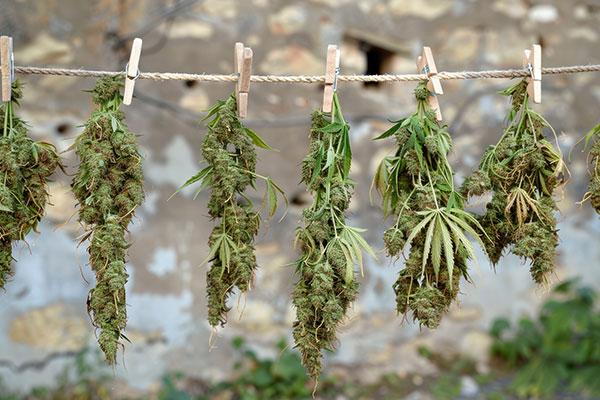
The Core Variables That Define Drying Conditions
Optimal cannabis drying conditions are determined by four key variables: temperature, humidity, airflow, and drying speed. These factors work together as a system that controls how moisture leaves the plant and how well quality is preserved after harvest. These same environmental variables also play a critical role during indoor cultivation.
If any of these variables is unbalanced, drying becomes inconsistent. This can lead to terpene loss, uneven moisture distribution, or increased mold risk. For this reason, growers must manage all four variables together, not separately, to achieve stable and predictable results.
Temperature
Temperature directly affects how quickly moisture leaves the plant.
Lower temperatures slow down the drying process and help preserve volatile compounds such as terpenes. On the other hand, higher temperatures accelerate drying but increase the risk of aroma loss and degradation.
Maintaining a stable, moderate temperature range during cannabis drying is essential to balance drying speed and quality retention. This is particularly important given how sensitive terpenes are to environmental conditions during post-harvest handling.
Humidity (Relative Humidity – RH)
Humidity controls how much moisture the surrounding air can absorb from the plant.
If relative humidity is too high, drying slows down and creates conditions where mold can develop. If it is too low, moisture leaves the plant too quickly, leading to overdried outer layers and trapped internal moisture.
Controlled relative humidity (RH) levels during cannabis drying ensure gradual, even drying across the entire flower.
Airflow
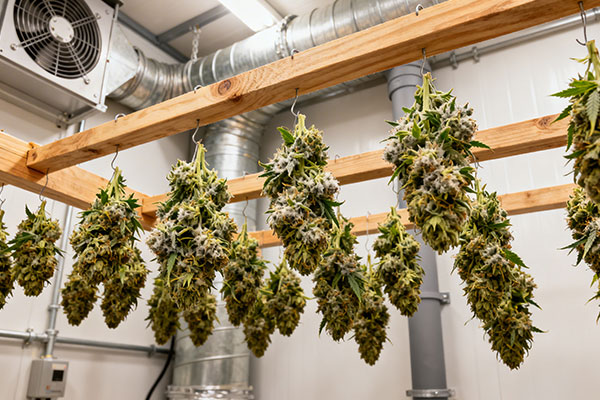
Airflow regulates how moisture is removed from the drying environment.
However, airflow must be indirect and evenly distributed. Strong, direct airflow in a cannabis drying room can dry the outer layer of the buds too quickly, creating an imbalance between the surface and the core.
Instead, controlled and consistent air exchange is required to:
- prevent stagnant air pockets
- maintain uniform conditions
- support stable drying across batches
Drying Speed
Drying speed is the result of temperature, humidity, and airflow combined.
Slow drying generally produces better results. It allows for:
- improved terpene retention
- smoother final product
- more consistent structure
In contrast, rapid drying often leads to lower quality and uneven results.
Drying speed also determines the overall drying duration. While exact timelines vary depending on environmental conditions, drying typically takes several days to two weeks. Slower drying under controlled conditions consistently produces better outcomes than accelerated drying.
For this reason, controlling drying speed is one of the most important factors in preserving value after harvest.
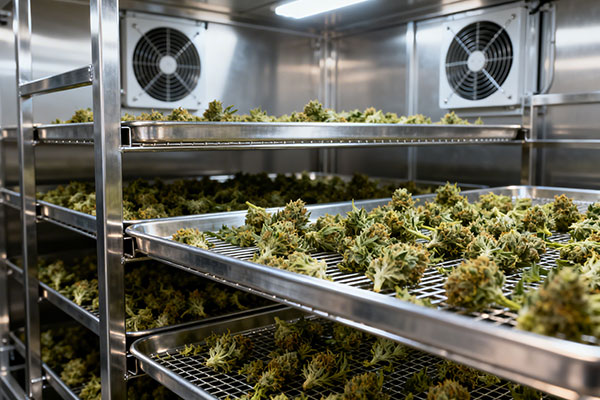
How Environmental Factors Interact
Drying conditions do not operate as separate variables. Temperature, humidity, and airflow are tightly connected and must be managed as a single environmental system.
Each adjustment directly influences how moisture moves from the plant into the surrounding air. For example:
- Higher temperature increases the air’s capacity to hold moisture, which lowers relative humidity and speeds up drying
- Increased airflow replaces humid air around the buds with drier air, accelerating moisture removal
- Changes in humidity affect how efficiently moisture evaporates, even if temperature remains constant
Because of these interactions, changing one variable always impacts the others. As a result, isolated adjustments often create unintended imbalances, such as uneven drying or excessive moisture loss.
Effective drying therefore requires coordinated control, not isolated adjustments. Growers who manage cannabis drying room conditions as an integrated system achieve more stable environments, more predictable drying times, and significantly more consistent product quality.
Common Drying Mistakes That Reduce Quality
Even experienced growers often encounter issues during drying due to unstable or poorly controlled conditions.
The most common mistakes include:
- Overdrying caused by low humidity or excessive airflow
- High temperatures that degrade terpenes and cannabinoids
- Poor air circulation leading to uneven drying or increased mold risk
- Inconsistent environmental control across different batches
- Rushing the drying phase to speed up turnaround
Avoiding these mistakes requires both proper setup and consistent monitoring.
Designing a Stable Cannabis Drying Environment
A reliable drying process depends on environmental stability.
Professional operations focus on:
- controlled drying rooms rather than improvised spaces
- consistent temperature and humidity management
- uniform airflow distribution
- continuous monitoring of conditions
The goal is not only to dry the current batch, but to consistently reproduce the same results across every harvest.
Consistency is what transforms drying from a risk into a predictable process.
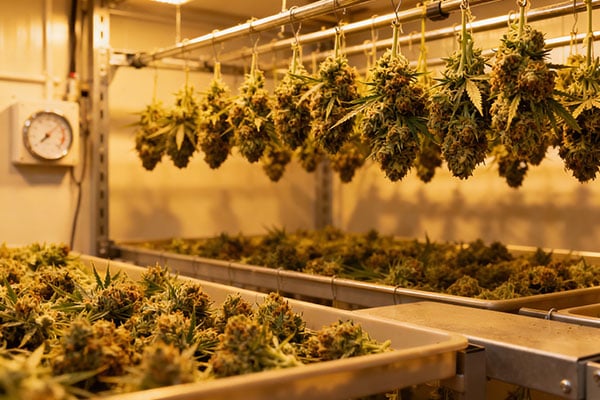
Drying as Part of a Larger Post-Harvest Workflow
Drying directly affects everything that follows. When drying conditions are inconsistent, downstream processes become less efficient. For example:
- trimming results become uneven, especially when inconsistent drying affects trimming speed and cutting precision
- product handling becomes more difficult
- quality variation increases across batches
On the other hand, stable drying conditions create a reliable foundation for post-harvest operations.
This is especially important when scaling production or integrating automated workflows. For instance, consistent drying improves the performance of trimming systems such as Ganatik, where uniform material allows for more predictable and efficient processing. Consistent drying also helps preserve valuable material, such as kief, improving recovery potential during processing.
Drying Impacts Final Quality
Drying is not just a transitional phase between harvest and processing. It is a precision-controlled step that ultimately defines product quality.
By managing temperature, humidity, airflow, and drying speed as a unified system, growers can:
- preserve terpene profiles
- maintain structural integrity
- reduce risk of defects
- achieve consistent, repeatable results
In modern cannabis production, optimal drying conditions are not optional. They are a core requirement for protecting quality and ensuring predictable outcomes at scale. Growers who treat drying as a controlled process, rather than a passive step, consistently achieve better results across every harvest.
For more insights into cultivation and post-harvest optimization, visit our Cannabis World hub.
FAQ: Optimal Cannabis Drying Conditions
What are the optimal drying conditions for cannabis after harvest?
Optimal cannabis drying conditions involve stable temperature, controlled relative humidity, and indirect airflow that enable slow, even moisture removal. These conditions help preserve terpene profiles, maintain bud structure, and ensure consistent final quality.
Why is slow drying better for cannabis quality?
Slow drying allows moisture to leave the plant gradually, which helps preserve terpenes, improves smoothness, and prevents uneven internal moisture distribution. As a result, the final product retains better aroma, structure, and usability.
What happens if cannabis dries too quickly?
If cannabis dries too quickly, terpenes can evaporate, leading to reduced aroma and flavor. In addition, rapid drying often causes uneven moisture distribution, resulting in harsh smoke and brittle flower structure.
How does humidity affect cannabis drying?
Humidity controls how efficiently moisture is removed from the plant. High humidity slows drying and increases mold risk, while low humidity accelerates drying and can lead to overdried outer layers with trapped internal moisture.
Does airflow improve cannabis drying?
Airflow improves drying when it is consistent and indirect. It helps remove humid air and maintain stable conditions. However, strong direct airflow can dry the outer layer of the buds too quickly, causing uneven drying.
What is the biggest mistake during cannabis drying?
One of the most common mistakes is trying to speed up drying by increasing temperature or airflow. This often leads to terpene loss, uneven moisture distribution, and reduced overall quality.

 Ganatik
 Re-Plant
 Marketing Support
 Cannabis World
 Terms & Conditions