
 Products
 For Distributors
 For Grow Shops
 About Miabis
 Contact
Soil vs Coco vs Rockwool
Choosing the Right Cannabis Growing Medium for Healthier Roots and Better Yields
Choosing the right growing medium is one of the most important decisions in cannabis cultivation. The substrate directly affects root development, oxygen availability, watering frequency, nutrient uptake, growth speed, and ultimately yield quality.
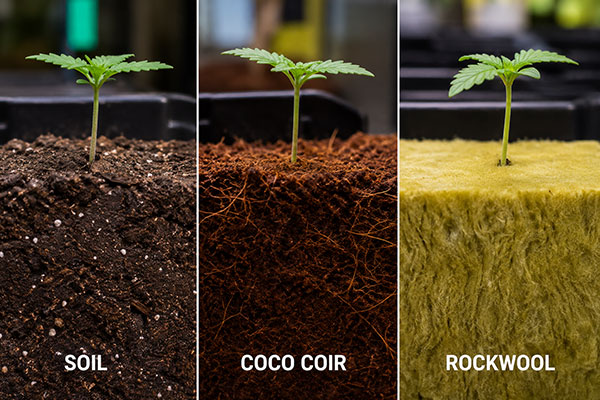
Most growers compare three main options: soil, coco coir, and rockwool. Each medium offers different advantages and disadvantages depending on the cultivation style, experience level, and production goals.
For example, some growers prefer simplicity and organic cultivation. Others focus on faster growth, higher yields, or compatibility with automated irrigation systems. As a result, there is no single “best” growing medium for cannabis. Instead, the ideal choice depends on the grower’s workflow and growing environment.
In this guide, we compare soil vs coco vs rockwool for cannabis and explain how each medium affects plant growth, root health, and overall cultivation efficiency.
What Makes a Good Cannabis Growing Medium?
A good cannabis growing medium should support healthy root development while maintaining the right balance between moisture retention and oxygen availability.
Although nutrients and lighting often receive the most attention, the growing medium plays an equally important role in cannabis cultivation. It determines how much water and oxygen reach the roots, how efficiently nutrients are absorbed, and how quickly the root system can expand. Even with excellent genetics and environmental conditions, an unsuitable substrate can limit plant performance and reduce yield potential.
When comparing soil vs coco coir vs rockwool for cannabis, growers should focus on several key characteristics that directly influence root health and overall plant development:
- water retention
- drainage performance
- root-zone oxygenation
- nutrient buffering
- irrigation management
- resistance to compaction
- compatibility with automated systems
Healthy roots need constant access to oxygen. Therefore, poorly aerated substrates can slow plant growth and increase the risk of overwatering, root diseases, and lower yields.
At the same time, the growing medium also affects how often plants need watering and feeding. Some substrates are very forgiving, while others require more precise irrigation and nutrient management.
Growing Cannabis in Soil
Soil is the most traditional and beginner-friendly cannabis growing medium. Many growers prefer soil because it provides a more natural cultivation approach and offers strong nutrient buffering.
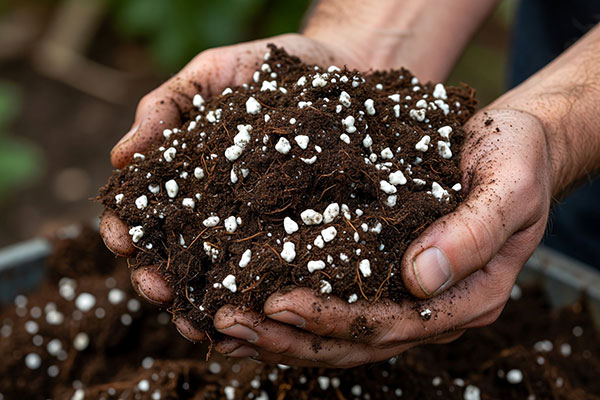
Advantages of soil:
- Beginner-Friendly Cultivation: First of all, soil is usually more forgiving than hydroponic-style media. Small watering or feeding mistakes are less likely to damage plants immediately.
- Natural Nutrient Buffering: In addition, high-quality soil contains organic matter and microorganisms that help regulate nutrient availability over time.
- Lower Watering Frequency: Because soil retains moisture longer than coco or rockwool, growers usually need to irrigate less frequently.
- Organic Growing Compatibility: Furthermore, many organic cannabis growers prefer living soil systems because they support natural cultivation practices and terpene development.
Disadvantages of soil:
- Reduced Oxygen Availability: On the other hand, dense or compacted soil can restrict airflow around the roots. Consequently, growth may slow down and root health can decline.
- Slower Growth Rates: Compared to coco or rockwool, soil-grown cannabis often develops more slowly because nutrient uptake is less aggressive.
- Greater Risk of Overwatering: Additionally, soil holds water longer, which means improper irrigation can create poor root-zone conditions.
Soil is best suited for:
- beginner growers
- organic cultivation
- low-maintenance grows
- growers who prefer simplicity over maximum speed
Growing Cannabis in Coco Coir
Today, coco coir is one of the most popular cannabis growing mediums in indoor cultivation. It combines many benefits of hydroponics with the familiarity of container growing.
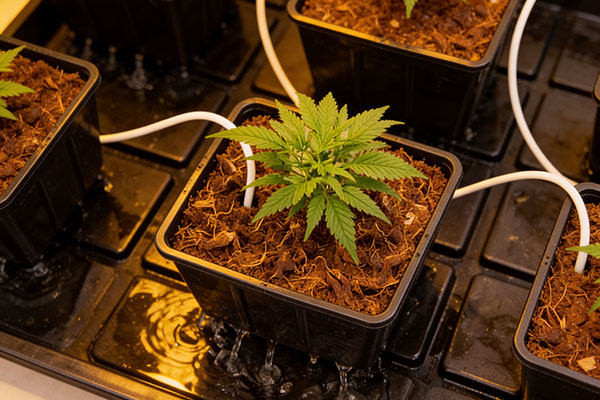
Advantages of coco:
- Faster Growth: One major advantage of coco is faster vegetative growth. Because the medium provides excellent oxygen availability, roots can expand quickly and efficiently.
- Better Root Aeration: Compared to soil, coco delivers significantly more airflow around the root zone.
- Hydroponic-Like Performance: As a result, many growers achieve faster nutrient uptake and improved yields with coco-based systems.
- Strong Drainage Characteristics: At the same time, coco drains efficiently while still retaining enough moisture for healthy root development.
Disadvantages of coco:
- Requires More Frequent Feeding: Unlike soil, coco contains very little nutritional value. Therefore, growers must feed plants more consistently.
- CalMag Management: In addition, coco tends to bind calcium and magnesium, so supplementation is often necessary.
- Faster Dry-Back: Because of its airy structure, coco usually dries faster and requires more frequent watering.
Coco is ideal for:
- indoor cannabis cultivation
- yield-focused growers
- automated drip irrigation systems
- growers seeking faster vegetative growth
Because coco promotes strong root oxygenation, container design also becomes more important. For example, poor airflow or root spiraling can still reduce overall root-zone efficiency.
Growing Cannabis in Rockwool
Rockwool (also known as stone wool) is widely used in commercial cannabis cultivation and hydroponic systems where precision control is essential.
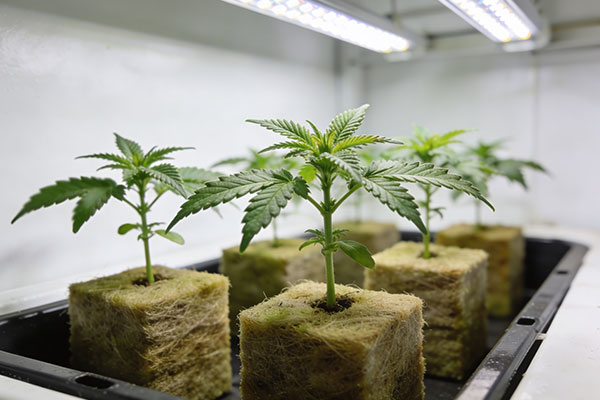
Advantages of rockwool:
- Excellent Oxygen Availability: One of the biggest advantages of rockwool is its high oxygen availability within the root zone. As a result, plants can grow very aggressively.
- Precision Irrigation Control: Since rockwool has minimal buffering capacity, growers can precisely manage nutrient delivery and EC levels.
- Automation Compatibility: Moreover, rockwool works extremely well in recirculating drip hydroponic systems and commercial irrigation setups.
- Consistent Moisture Distribution: In addition, the material distributes water evenly throughout the root zone.
Disadvantages of rockwool:
- Less Forgiving: However, mistakes in feeding or irrigation can affect plants very quickly because rockwool provides little natural buffering.
- Environmental Concerns: Unlike soil or coco, rockwool is a manufactured mineral product and is generally considered less environmentally friendly.
- Higher Skill Requirement: For this reason, rockwool cultivation usually requires greater precision and monitoring.
Rockwool is best suited for:
- advanced growers
- commercial cannabis facilities
- automated hydroponic systems
- high-frequency fertigation
As expected, growers using rockwool often focus heavily on irrigation timing, root-zone optimization, and oxygen management to maximize yields.
Soil vs Coco vs Rockwool Comparison
When comparing soil vs coco vs rockwool for cannabis, there is no single medium that outperforms the others in every situation. Each option offers a different balance of root-zone oxygenation, water retention, ease of use, growth rate, and yield potential. The table below highlights the key differences to help you choose the growing medium that best fits your cultivation style and goals.
| Feature | Soil | Coco Coir | Rockwool |
|---|---|---|---|
| Ease of use | High | Medium | Low |
| Growth speed | Medium | Fast | Very Fast |
| Oxygen availability | Medium | High | Very High |
| Water retention | High | Medium | Medium |
| Drainage | Medium | High | High |
| Nutrient buffering | High | Low | Very Low |
| Automation compatibility | Low | High | Very High |
| Yield potential | Medium | High | Very High |
| Irrigation frequency | Low | Medium-High | High |
| Beginner friendliness | Excellent | Moderate | Low |
| Commercial suitability | Medium | High | Very High |
While this comparison provides a useful overview, the best cannabis growing medium ultimately depends on your experience level, cultivation method, and desired results. Soil is often preferred for simplicity, coco offers an excellent balance of performance and usability, while rockwool is typically chosen for highly controlled hydroponic systems and maximum production potential.
Which Growing Medium Produces the Best Cannabis Yields?
One of the most common questions when comparing soil vs coco vs rockwool for cannabis is which growing medium produces the highest yields. While the growing medium can influence plant growth and root development, it is only one factor in the overall cultivation system.
Yield depends on much more than the growing medium alone. For example, environmental control, genetics, irrigation strategy, lighting, and root health all play major roles in cultivation performance.
However, in optimized environments:
- rockwool often delivers the highest production potential
- coco offers an excellent balance between yield and ease of use
- soil prioritizes simplicity and organic cultivation rather than maximum growth rates
For many growers, coco represents the middle ground between traditional soil cultivation and high-performance hydroponics. As a result, it has become one of the most popular growing media for indoor cannabis cultivation.
Can You Combine Different Cannabis Growing Mediums?
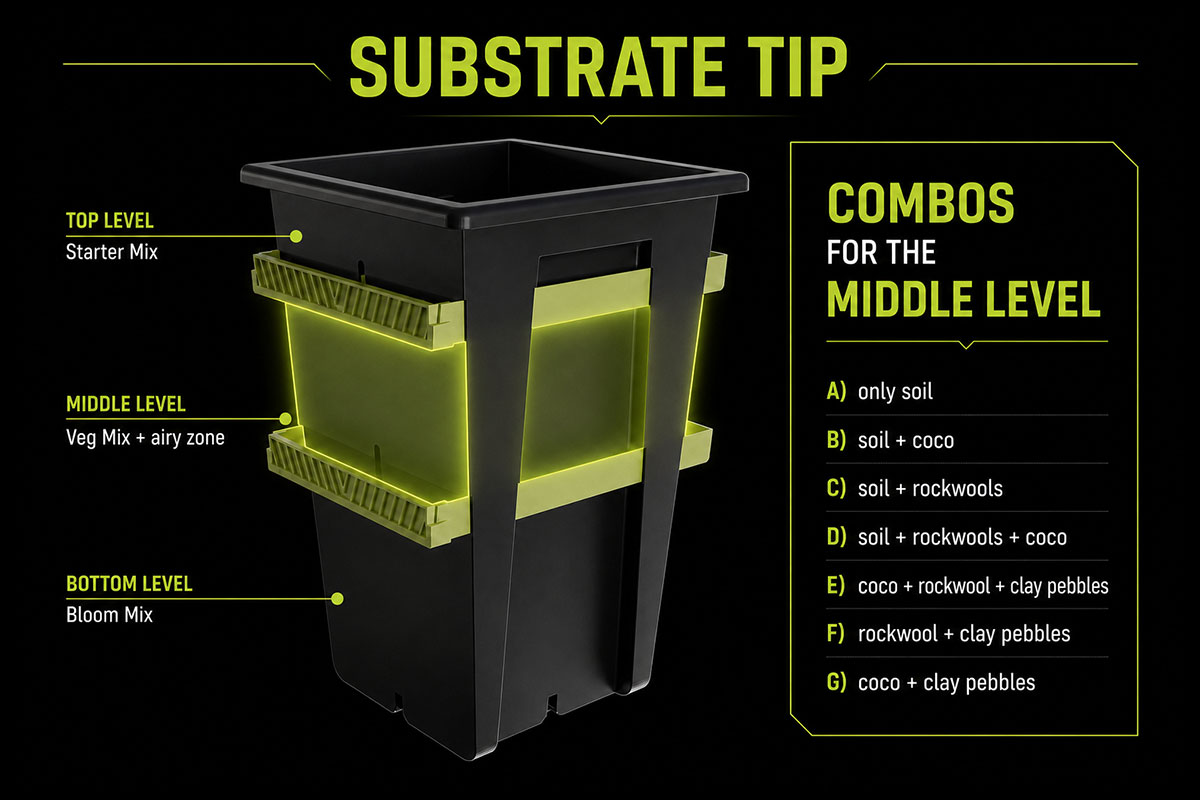
Yes. In fact, many growers combine substrates to balance moisture retention, drainage, and root oxygenation.
Common examples include:
- soil with added perlite
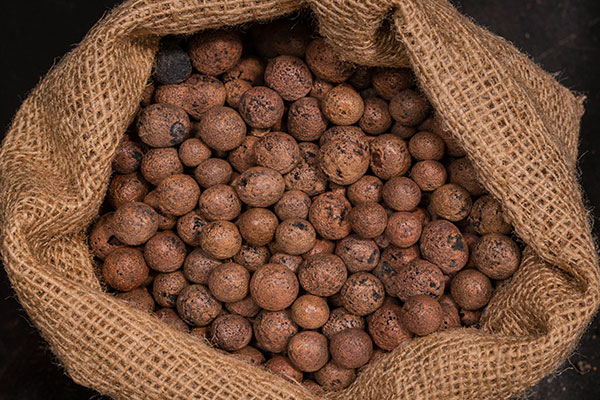
- coco mixed with clay pebbles
- rockwool integrated into drip systems
- layered substrate approaches
Additionally, different growth stages may benefit from different substrate characteristics.
This is where advanced container systems become especially useful. For example, the RE-PLANT cultivation container was specifically designed to allow growers to use different substrates in different root zones while avoiding transplant stress.
The patented container uses pull-out trays that divide the pot into multiple compartments, allowing staged root expansion as the plant develops.
As a result, growers can:
- expand root volume gradually
- improve substrate utilization
- reduce transplant stress
- optimize root-zone airflow
In addition, RE-PLANT supports continuous oxygen supply and helps reduce root spiraling through its airflow-oriented design.
Choosing the Right Container Matters Too
While growing medium selection is important, it should not be viewed in isolation. The performance of any substrate is closely linked to the container that holds it. Factors such as airflow, drainage, root expansion, and root-zone volume can significantly influence how effectively soil, coco, or rockwool perform throughout the cultivation cycle.
In practice, root-zone performance depends on:
- oxygen availability
- drainage
- root expansion
- irrigation consistency
- prevention of root circling
Traditional containers often force growers to transplant multiple times during cultivation, which can stress plants and temporarily slow growth. To solve this problem, RE-PLANT was developed with staged volume expansion inside a single container.
At the same time, the system allows growers to use the full substrate volume more efficiently while maintaining strong root aeration throughout the cultivation cycle.
For growers using coco or hydroponic-style irrigation systems, root-zone oxygenation becomes especially important because faster-growing roots require a continuous supply of air to support healthy development.
When comparing soil vs coco vs rockwool, there is no single “best” growing medium for cannabis cultivation. Instead, the right choice depends on the grower’s experience level, cultivation style, environmental control, and production goals.
In general:
- soil is ideal for simplicity and organic growing
- coco offers a strong balance between performance and usability
- rockwool provides maximum precision and commercial-scale efficiency
Regardless of the substrate, healthy root development remains one of the most important factors in cannabis cultivation success.
As modern cultivation continues evolving, growers increasingly focus not only on nutrients and lighting, but also on root-zone airflow, container efficiency, and transplant reduction. Ultimately, all of these factors directly influence long-term plant performance.
FAQ: Choosing Growing Medium for Cannabis
Which growing medium is best for cannabis?
There is no single best growing medium for cannabis. The right choice depends on your experience level, cultivation method, and goals. Soil is the most beginner-friendly option, coco coir offers a strong balance of growth performance and ease of use, while rockwool is often preferred in commercial hydroponic systems where maximum control and yield potential are priorities.
Is coco better than soil for cannabis?
Coco coir can produce faster growth and higher yields than soil because it provides better root-zone oxygenation and more direct control over nutrient delivery. However, it also requires more frequent watering and feeding. Soil is generally more forgiving and easier to manage, making it a popular choice for beginners and organic growers.
Is rockwool good for cannabis cultivation?
Yes, rockwool is one of the most widely used growing media in commercial cannabis cultivation. It offers excellent water retention, high oxygen availability, and compatibility with automated irrigation systems. However, because it provides very little nutrient buffering, it requires more precise management than soil or coco.
Is coco or rockwool better for cannabis?
Coco coir is usually easier to work with than rockwool while still providing many of the benefits of hydroponic cultivation. Rockwool offers greater precision and automation potential, but it also requires closer monitoring of irrigation and nutrient levels. For many growers, coco provides the best balance between performance and ease of use.
Which growing medium gives the biggest cannabis yields?
Under optimized growing conditions, coco coir and rockwool often produce higher yields than soil. Their superior oxygenation and efficient nutrient delivery can support faster growth and greater plant productivity. However, environmental conditions, genetics, lighting, and cultivation practices have a significant impact on final yields regardless of the growing medium.
Can you mix cannabis growing mediums?
Yes, many growers combine different growing media to improve drainage, water retention, or root-zone oxygenation. Common combinations include soil with perlite, coco with clay pebbles, or rockwool used within hydroponic systems. The best mix depends on the cultivation method and the grower’s goals.
What is the easiest growing medium for beginners?
Soil is generally considered the easiest growing medium for beginner cannabis growers. It retains moisture longer, buffers nutrients naturally, and is more forgiving of minor watering or feeding mistakes. These characteristics make soil a good choice for growers who are still learning the basics of plant care.

 Ganatik
 Re-Plant
 Marketing Support
 Cannabis World
 Terms & Conditions