
 Products
 For Distributors
 For Grow Shops
 About Miabis
 Contact
Air pruning cannabis roots is one of the most effective ways to improve plant growth and root system performance. Healthy roots are the foundation of every successful cannabis grow. While most growers focus on lighting, nutrients and genetics, the root system is often overlooked, yet it directly determines how efficiently a plant can absorb water, nutrients and oxygen.
In many cases, root problems go unnoticed until plants begin to show slowed growth, uneven development or reduced yield potential. By that point, limitations below the surface are already affecting the entire system.
One of the most common hidden issues in cannabis cultivation is root circling. In traditional containers, roots follow the container walls, forming dense spirals that restrict nutrient uptake and overall plant performance.
Air pruning offers a practical solution. By changing how roots grow, it improves root structure, prevents circling and creates the conditions for stronger, more efficient plants.
What Is Air Pruning?
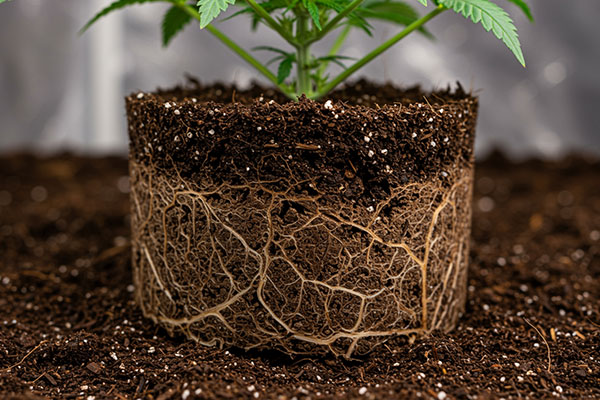
Air pruning is a root growth process where root tips stop growing when exposed to air, triggering the development of new lateral roots and creating a dense, fibrous root system.
When a root reaches the edge of an aerated container, the tip dries out and naturally stops elongating. Instead of continuing to grow in one direction, the plant responds by producing multiple new side roots behind the tip.
This process results in a more evenly distributed root system with greater surface area for nutrient and water uptake. Compared to root growth in closed containers, air pruning prevents circling and promotes more efficient use of the available root zone.
This process mimics how roots behave in natural soil environments, where they constantly branch and adapt instead of becoming restricted.
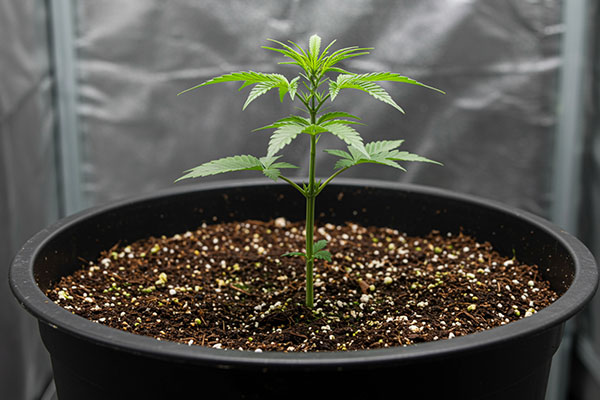
How Air Pruning Works in Cannabis Cultivation
In cannabis cultivation, air pruning typically happens in containers that allow airflow through their sides.
As roots grow outward and reach the container wall:
- they encounter oxygen-rich air
- the root tip is naturally “pruned”
- new secondary roots begin forming
Over time, this results in:
- a dense network of fine roots
- improved nutrient absorption
- more uniform root distribution throughout the substrate
This type of root structure is significantly more effective than a few long, circling roots.
The Problem: Root Circling in Traditional Pots
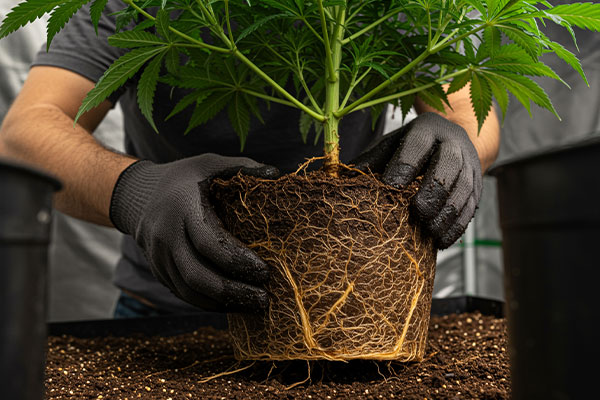
Standard plastic pots restrict airflow. Their solid walls force roots to follow the path of least resistance – usually circling around the container.
This creates several problems:
- roots begin to spiral and wrap around themselves
- the plant becomes root-bound
- nutrient and water uptake becomes less efficient
- oxygen availability is limited
Over time, this reduces plant vigor and can directly impact final yield and consistency. In commercial cultivation, this often translates into inconsistent plant performance and lost yield potential.
Root circling is not always visible above ground, but it is one of the key limiting factors in cannabis cultivation.
Benefits of Air Pruning for Cannabis Plants
Air pruning cannabis roots doesn’t just improve root health, it fundamentally changes how the root system develops, leading to more efficient resource uptake and more consistent plant performance throughout the entire growth cycle:
- More Fibrous Root Systems – Instead of long, inefficient roots, plants develop dense networks of fine roots that maximize surface area.
- Better Nutrient Uptake – More root tips mean more active absorption zones, leading to improved nutrient efficiency.
- Improved Oxygen Availability – Airflow around the root zone supports healthier root metabolism and reduces the risk of anaerobic conditions.
- Faster, More Stable Growth – Plants experience fewer restrictions and can maintain steady development throughout the growth cycle.
- Reduced Risk of Root-Bound Plants – Air pruning naturally prevents roots from circling and compacting.
As a result, plants are able to use water, nutrients and available space more efficiently, which directly supports stronger growth, better uniformity and improved yield potential.
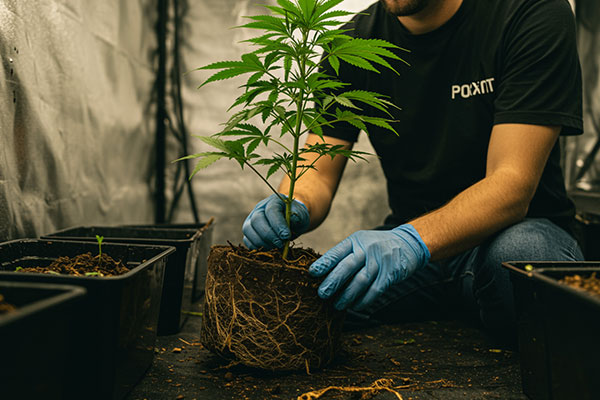
Air Pruning vs Traditional Containers
The way roots develop is directly influenced by container design. Different container types create very different root environments, which impacts how efficiently plants can grow and perform.
Traditional plastic pots:
- limited airflow
- high risk of root circling
- uneven root distribution
In traditional containers, solid walls restrict oxygen flow and force roots to grow along the edges. This often leads to spiraling, root binding and inefficient use of the available substrate.
Fabric pots and other aereated containers:
- improved airflow
- natural air pruning
- better root structure
Aerated containers allow air to reach the root zone, which enables natural air pruning. Instead of circling, roots branch out into a dense, fibrous network that uses the container volume more effectively.
The key difference is not just airflow, but how that airflow shapes root behavior over time.
However, while these systems significantly improve root health, they do not solve all cultivation challenges, especially when it comes to workflow, scalability and container management.
Airflow and Oxygen: The Missing Factor in Root Health
Roots require oxygen to function properly. Without sufficient oxygen:
- Nutrient uptake slows down
- Root growth becomes inefficient
- Risk of overwatering increases
Air pruning systems improve oxygen availability by allowing continuous air exchange at the container walls.
This creates a more balanced root zone where water, nutrients and oxygen work together, instead of competing.
Oxygen is just one part of the root environment, and one of several factors that influence how cannabis plants grow and perform.
Limitations of Air Pruning Systems
Despite its benefits, air pruning is not a complete solution. Growers still face several challenges:
- containers often dry out faster
- watering requires more precision
- plants still need to be transplanted into larger pots as they grow
- increased labor and operational complexity in larger setups
This creates a gap between improved root health and overall cultivation efficiency. This is especially important for commercial growers, where transplanting becomes time-consuming and costly.
A Smarter Approach: Combining Air Pruning with Scalable Root Space
Air pruning improves root quality, but it does not eliminate the need for transplanting. This is where more advanced cultivation systems start to address not just root health, but the entire growing workflow.
Instead of moving the plant into larger containers, a more efficient approach is to let the container grow with the plant, while maintaining airflow and root structure.
The Re-Plant container follows this concept:
- continuous oxygen supply to the root system
- anti-root-spiraling design through airflow and structure
- adjustable container volume using pull-out trays
- no transplanting required at any stage
This allows growers to combine the benefits of air pruning with a more efficient workflow – reducing stress on both the plant and the grower.
As a result, roots develop naturally without restriction, plants avoid transplant shock entirely, and growers save time, labor, and space.
This approach reflects a broader shift in modern cultivation – from managing containers to optimizing root environments.
Practical Tips for Growers
Implementing air pruning effectively requires small adjustments in how you manage your grow:
- use containers that allow sidewall airflow
- monitor watering closely – airflow increases evaporation
- avoid overwatering, especially in early stages
- ensure proper drainage and substrate structure
- match your system to your grow scale (home vs commercial)
For advanced setups, consider solutions that combine airflow with scalable container volume to reduce transplanting.
Air pruning cannabis roots is one of the most effective ways to improve root health and overall plant performance. By preventing root circling and encouraging fibrous growth, it creates a stronger foundation for nutrient uptake, stability and yield.
However, the biggest gains come from combining air pruning with smarter cultivation systems – ones that eliminate unnecessary stress, reduce labor and allow roots to develop without interruption. In modern cannabis cultivation, controlling the root zone means controlling the entire plant.
FAQ: Air Pruning Cannabis Roots
What is air pruning in cannabis plants?
Air pruning is a root growth process where root tips stop growing when exposed to air, triggering the formation of new lateral roots and creating a dense, fibrous root system.
Does air pruning increase cannabis yield?
Indirectly, yes. Air pruning improves root structure and nutrient uptake efficiency, which supports stronger growth, better plant uniformity and higher yield potential.
How does air pruning prevent root circling?
When roots reach the edge of an aerated container, exposure to air stops further elongation. Instead of circling, the plant produces new side roots, preventing spiraling and root binding.
Are aerated containers better for cannabis roots?
Aerated containers improve airflow and support air pruning, leading to healthier root systems. However, most still require transplanting and careful watering management to maintain optimal conditions.
Do you still need to transplant with air pruning pots?
Yes. Most aerated containers do not adjust in size, so plants typically need to be transplanted into larger containers as they grow.
Does air pruning affect watering frequency?
Yes. Aerated containers increase airflow and evaporation, which means the substrate can dry out faster. Growers typically need to water more frequently and monitor moisture levels more closely.

 Ganatik
 Re-Plant
 Marketing Support
 Cannabis World
 Terms & Conditions